
Subscribe to our newsletter
for the latest edTech news, free resources and competitions!
Self-evaluation under Ofsted's new framework: What school leaders need to rethink
Jan. 22, 2026
Ofsted’s updated inspection framework has brought renewed focus on the quality, clarity and credibility of a school’s self-evaluation. For headteachers and senior leaders, this isn’t simply a technical change - it’s a shift in how evaluation supports leadership decision-making and school improvement.
Many schools already have self-evaluation processes in place. But under the new framework, leaders are increasingly expected to demonstrate not just what they think about their provision, but how those judgements are formed, evidenced and used to drive improvement.

Self-Evaluation: From compliance to confidence
Historically, self-evaluation has sometimes become a compliance exercise: something completed periodically, often under time pressure, and revisited mainly in preparation for inspection.
The new framework places greater emphasis on:
- Clear, well-reasoned judgements
- Evidence that is purposeful and connected to practice
- Evaluation that feeds directly into improvement planning
This means self-evaluation needs to be ongoing, structured and usable - something leadership teams can return to regularly, rather than a static document.
The challenge for school leaders
For most senior leaders, the challenge isn’t a lack of professional insight. It’s time, consistency and organisation.
Leadership teams are expected to:
- Evaluate across hundreds of inspection criteria
- Maintain secure, accessible evidence
- Involve staff and governors meaningfully
- Ensure judgements remain aligned to national expectations
Trying to manage this through disconnected documents, spreadsheets and folders makes the process harder than it needs to be - and risks undermining confidence when it matters most.
Why alignment to Ofsted's new framework matters more than ever
Under the updated framework, alignment to Ofsted’s criteria is critical. Leaders need to be confident that:
- Their judgments reflect current inspection language
- Evidence is mapped clearly to relevant subcategories
- Improvement actions genuinely address identified priorities
How Know my School can help support schools with the new Ofsted inspection framework
An updated version of Know My School, fully aligned with the November 2025 framework, supports this by structuring self-evaluation directly around Ofsted’s expectations. Thousands of graded good-practice statements from high-performing schools help leaders benchmark their provision realistically and consistently.
This doesn’t replace professional judgement - it strengthens it.
Know my School and the role of AI in modern self-evaluation
One of the most significant developments in the updated Know My School is the careful, integrated use of artificial intelligence.
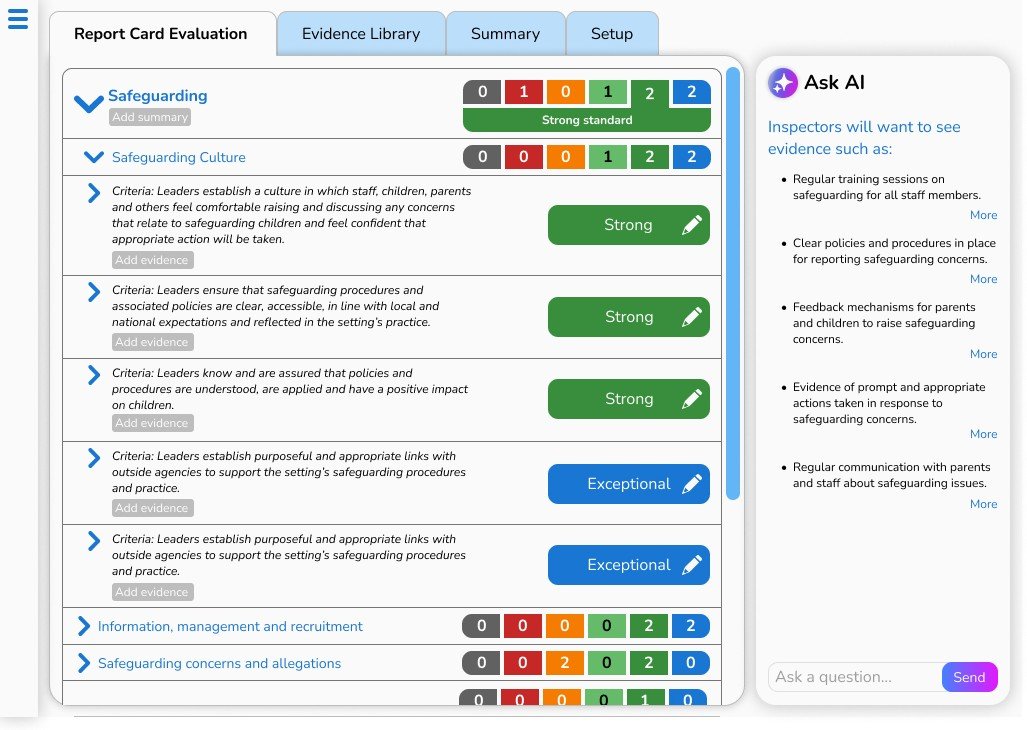
Used well, AI doesn’t make decisions for leaders. Instead, it:
- Provides contextual guidance linked to specific evaluation points
- Offers examples of best practice aligned to Ofsted expectations
- Suggests improvement actions that leaders can adapt and refine
Crucially, this support is embedded within the self-evaluation process. Leaders don’t need to prompt or query it separately - relevant guidance appears where it’s needed, helping to maintain momentum and consistency.
For busy senior leadership teams, this can save hours while also improving the quality and clarity of written evaluations.
Evidence that works harder
Another key shift under the new framework is how evidence is used.
Evidence is no longer about volume; it’s about relevance, accessibility and coherence. A centralised evidence library - where documents, policies, data and examples are securely stored, automatically tagged and easily reused - allows leaders to spend less time searching and more time evaluating.
When evidence can be quickly linked to multiple inspection areas, self-evaluation becomes more fluid and far more helpful.
A leadership tool, not an inspection document
Perhaps the most crucial rethink is this: self-evaluation should primarily serve leaders, not inspectors.
When done well, it:
- Supports strategic conversations with governors
- Informs improvement planning and policy review
- Provides clarity and confidence across the leadership team
The updated Know My School is designed with this in mind — helping leaders create clear report cards in formats that mirror Ofsted’s, while also supporting deeper internal understanding.
In a changing inspection landscape, confident leadership begins with confident self-evaluation.
Find out how Know my School can support your school's improvement journey
Find out more about Know my School's updates in a free webinar - you'll be guided through the updated Self-Evaluation module and see the new, integrated AI.