
Subscribe to our newsletter
for the latest edTech news, free resources and competitions!
From judgement to action: using self-evaluation to drive school improvement
Jan. 29, 2026
Self-evaluation only adds real value when it leads to better outcomes for pupils. Under Ofsted’s new inspection framework, this connection between judgement and action is more important than ever.
For senior leaders, the key question is no longer “Have we evaluated ourselves?” but “How effectively are we using that evaluation to improve?”
Why school self evaluation often fails to drive improvement
Many schools can articulate strengths and areas for development. The challenge often lies in translating that insight into:
- Clear improvement priorities
- Coherent actions
- Shared understanding across leadership and governance
When self-evaluation exists separately from improvement planning, its impact is limited.
The updated Know My School addresses this by bringing evaluation, evidence and action into a single, structured process.

Making robust self-evaluation judgements aligned with Ofsted
At the heart of effective improvement planning is confident judgment.
Know My School supports this through:
- A clear five-point judgement scale aligned to Ofsted language
- Graded good-practice statements drawn from high-performing schools
- The ability to add contextual narrative to reflect a school’s unique circumstances
This combination helps leadership teams move beyond vague or cautious judgements, towards clarity and consistency.
Using AI to strengthen school improvement planning
A standout feature of the updated platform is its integrated AI support - not as a shortcut, but as a thinking partner.
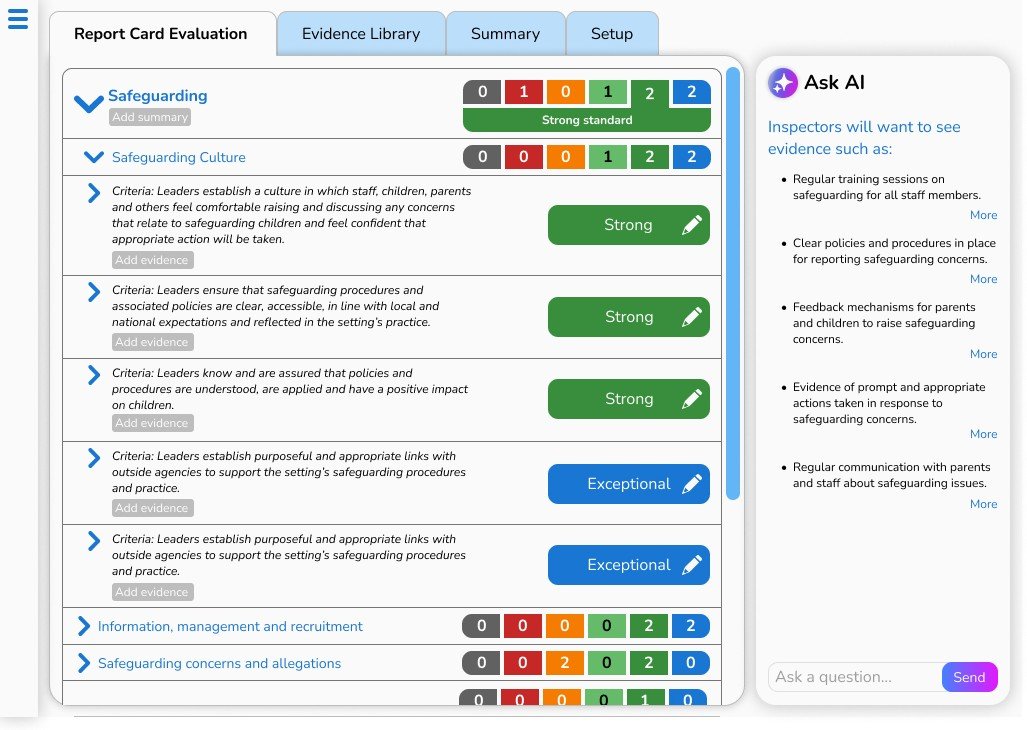
Within each evaluation area, AI can:
- Prompt leaders to consider relevant aspects of practice
- Suggest improvement actions aligned to the identified weaknesses
- Support policy review by highlighting expectations within the framework
This is particularly valuable when teams are revisiting areas that haven’t been inspected recently, or when new leaders are building confidence in unfamiliar inspection criteria.
Importantly, leaders remain in control. AI suggestions can be accepted, adapted or ignored - but they help ensure improvement planning is rooted firmly in the inspection framework.
Managing evidence effectively for Ofsted inspection and improvement
School improvement depends on an accurate understanding. That requires evidence that is:
- Easy to access
- Clearly linked to evaluation
- Shared confidently with others
The secure evidence library within Know My School allows leaders to store any evidence - policies, data, images, videos - and reuse it across multiple evaluation areas. Automatic tagging against framework subcategories ensures nothing is lost or overlooked.
This makes conversations with governors more focused, and improvement planning more precise.
Improving collaboration between school leaders and governors
Improvement is a collective effort. Know My School enables leaders to:
- Share self-evaluation and report cards easily with staff and governors
- Provide clarity around priorities and next steps
- Maintain a consistent narrative across leadership, governance and inspection
With report formats closely mirroring Ofsted’s own models, communication becomes more straightforward and more transparent.
Embedding continuous school improvement under the Ofsted framework
Perhaps the most powerful shift is cultural.
When self-evaluation is easy to update, clearly structured and genuinely helpful, it becomes part of everyday leadership practice - not a once-a-year task.
The updated Know My School supports this ongoing approach, helping leaders revisit judgements, refine actions and respond confidently to change.
Under the new Ofsted framework, improvement isn’t about reacting quickly. It’s about thinking clearly - and acting purposefully.