Subscribe to our newsletter
for the latest edTech news, free resources and competitions!
How Knowledge Organisers Support Retrieval Practice
Aug. 6, 2026
Retrieval practice is an effective learning strategy which helps children remember what they've learned, embedding the knowledge more deeply than just learning it once.
One simple way to support retrieval practice in the primary classroom is with knowledge organisers. By bringing together key facts, vocabulary and concepts from a topic in one place, they give pupils a handy reference point to use to revisit learning.
Why Retrieval Practice is Important
Research has shown that regularly recalling previously learned information helps strengthen memory and improves long-term retention, making retrieval practice a valuable strategy for primary classrooms (EEF, 2021).
Retrieval Practice Examples
Some examples of retrieval practice (that you're probably already using in your classroom) are:
- Sharing concepts and methods on mini whiteboards
- Talk partners
- Quizzes and asking questions about understanding
- Homework to practice what's been taught that week
- Using flashcards
What are Knowledge Organisers?
A knowledge organiser is a resource that collates all the important information for a topic in one place, making it easy to revisit the essentials whenever needed.
Knowledge organisers can include:
- Key vocabulary and definitions
- Important facts and information
- Diagrams and images
- Key concepts and questions
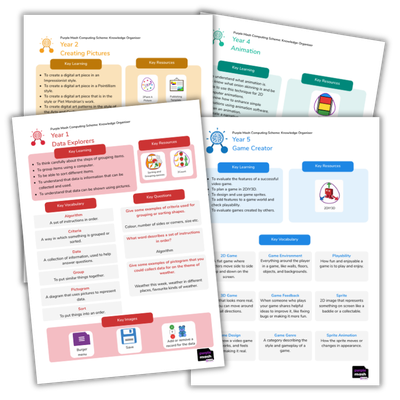
With Purple Mash, teachers can access ready-made knowledge organisers for computing, helping save planning time while ensuring pupils have access to high-quality resources that support learning. You can get a free sample selection of them here.
How to Use Knowledge Organisers
Knowledge organisers can be used at different points through a unit of work, and beyond.
Before starting a topic
- Introduce key vocabulary
- Discuss prior knowledge
- Set expectations for what will be learned
During lessons
- As a lesson starter
- Refer back to them when teaching
- Display them on the board
- Ask pupils to explain concepts using the organiser
Retrieval Games & Activities
- One-minute memory challenge
- Cover and recall
- Partner quizzes
- True or False
At the end of a topic
- Homework
- Revision
- Preparing for assessment
Knowledge Organisers for KS1 and KS2 Computing
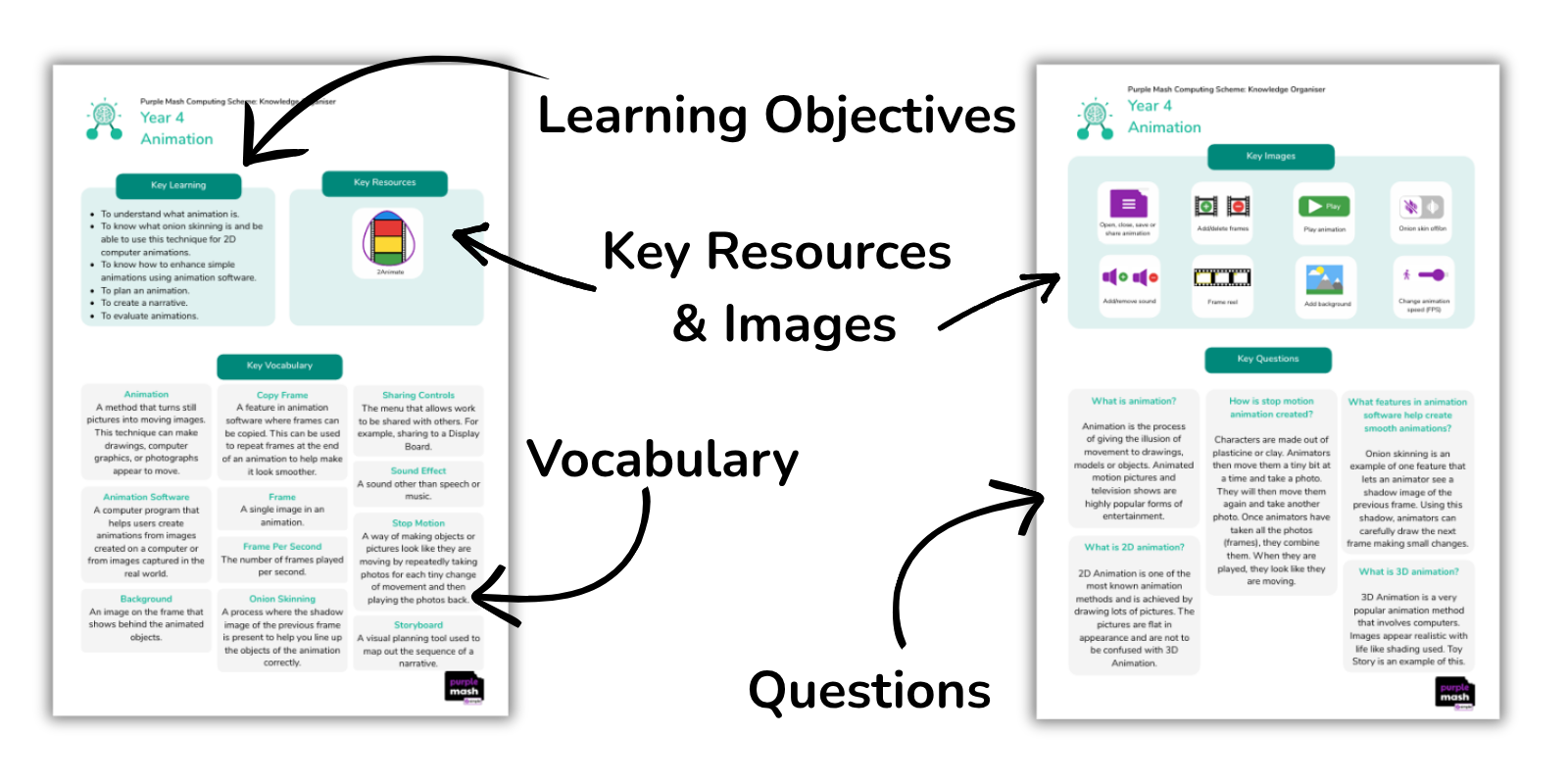
Want to try using Knowledge Organisers in your computing lessons? Purple Mash users get ready-made knowledge organisers which lay out key learning, resources, vocabulary, images and questions in an easy-to-read format. These are accessible for Year 1-6 and have been created for every single unit in the Computing Scheme.
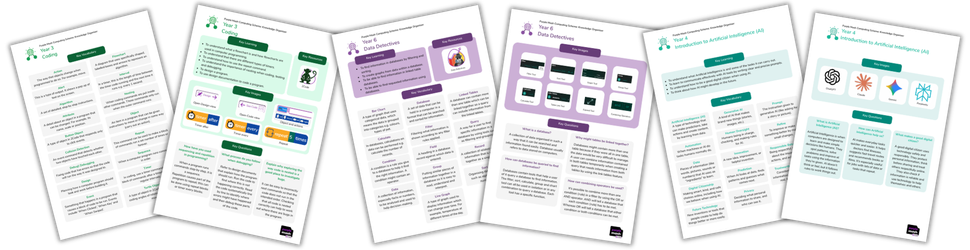
There are also editable versions available so that you can add features that you would like to include for your own school’s Knowledge Organisers. For example, if you want your pupils to write a summary of the learning of each lesson, you can add a section for this to the Knowledge Organiser, a perfect way to recap learning while children are learning at home.
When using Purple Mash tools in a cross-curricular context, pupils will be able to refer to the relevant Knowledge Organisers to jog their memories. For example, a Year 4 child using 2Animate to tell the animated story of a science or history topic, will have their Knowledge Organiser for Animation available to refer to, which will cut down on the need to re-teach the tool that the children have already used.
Free Computing Knowledge Organisers
We wanted to give you a taste of what our Knowledge Organisers include so we’ve put together a free downloadable pack with example PDF Knowledge Organisers from different units. These include:
- Year 1 - Data Explorers
- Year 2 - Creating Pictures
- Year 4 - Animation
- Year 5 - Game Creator
Each knowledge organiser outlines the key vocabulary, concepts, and knowledge pupils need for a specific unit, making them a valuable tool for teaching, revision, and supporting pupil progress.